By Lauren Calicchia, BSc. MD student University of Toronto
What is Melanoma?
Melanoma is a type of skin cancer that begins in melanocytes. These are the cells that produce pigment in the skin [1]. It often appears as a new or changing mole and, when detected early, is highly treatable. However, melanoma can become life-threatening if it spreads, making prevention and early awareness necessary for overall health and well-being [2].
Rethinking Melanoma Risk in Canada
There are many individuals that carry the false belief that their risk of melanoma is highest in the sunniest, hottest areas of Canada. However, the unfortunate reality is that cloudier regions of the country still report high melanoma rates. This is because UV exposure is always a risk regardless of the number of sunny days and therefore is a concern for all regions of Canada [3].
This article will explore provincial melanoma statistics, geography and risk, public misconceptions about melanoma risk, and why rates of skin cancer are rising.
Melanoma in Canada: Provincial Trends
Incidence rate refers to the number of new cases of melanoma diagnosed each year. Across Canada, there is notable variation between provinces, though not always in ways people may expect.
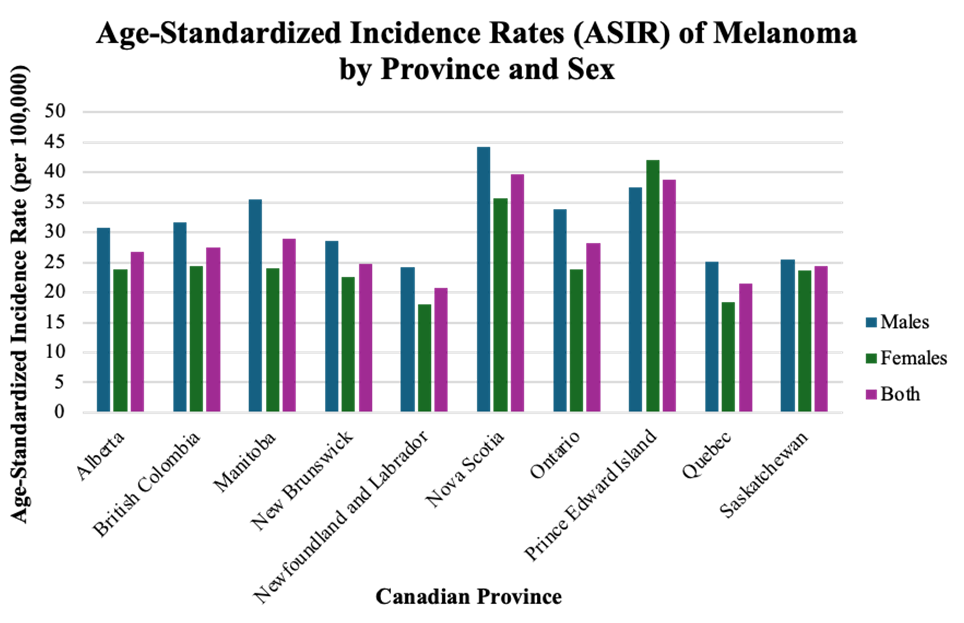
While some of the highest rates are observed in provinces like Nova Scotia and Prince Edward Island, melanoma is not limited to traditionally “sunny” areas. Even regions with cooler or cloudier climates report high rates of skin cancer. This challenges the assumption that areas with less sun automatically means lower risk, as the rates of melanoma remain high across all geographic areas.
Geographical Areas: Why “Less Sun” Doesn’t Mean Less Risk
At first glance, it may seem logical that provinces with less sunshine would have lower melanoma rates. However, several factors help explain why this is not the case:
- Intermittent Intense UV Exposure: Canadians may receive less consistent sun exposure overall compared to other countries but often experience short periods of high-intensity UV exposure during the summer and vacations. These intermittent exposures, while short in duration, contribute to one’s overall melanoma risk [5].
- Outdoor Activities: Many Canadians enjoy outdoor activities such as skiing in the winter and boating, hiking, and outdoor trips in the summer. Even in cooler weather, these activities can result in chronic UV exposure, significantly contributing to the risk of developing melanoma [6].
- Areas of Higher Altitude: Regions of Canada that are located at a higher altitude, such as British Colombia, experience stronger UV radiation. This is because areas of high-altitude experience thinner atmospheric protection, putting individuals in these areas at a higher risk of UV damage compared to other places in Canada [6].
- Reflection: Surfaces such as snow and water reflect UV rays, increasing total exposure. For example, snow can reflect up to 80% of UV radiation, meaning exposure can occur even in winter conditions [6].
The Hidden Risk: UV Exposure Happens With and Without Sun
One of the most important misconceptions about one’s risk of melanoma is that UV exposure is only damaging on hot, sunny days. However, this is simply not the case. In fact, up to 80% of UV rays can penetrate cloud, fog, and haze, which may contribute to ongoing exposure even when people don’t perceive it as a risk [7]. According to the World Health Organization, approximately 85% of new melanoma cases are linked to UV radiation [8]. A simple way to think about this is if there is daylight, there is UV exposure, regardless of how sunny it is.
There is a clear mismatch between how people perceive melanoma risk and how it actually occurs; this impacts individual behaviours. Some misconceptions include:
| “I don’t need sunscreen if it’s cloudy” | “Canada doesn’t get strong UV radiation” |
|
“Sun protection only matters in summer” |
These beliefs can lead to inconsistent sun protection behaviours and an accumulation of UV exposure and damage over time, which is a significant contributor to one’s lifetime melanoma risk.
Why Are Melanoma Rates Still Rising in Canada?
Despite increased awareness, melanoma rates in Canada continue to rise. Several factors contribute to this trend:
- Behavioral Patterns: Intermittent sun exposure, such as direct sun exposure in the summer, vacation tanning, and outdoor activities as previously discussed, is very common and associated with melanoma [6].
- Aging Population: As Canada’s population ages, melanoma risk also rises. Melanoma risk increases with age due to the accumulation of UV exposure causing damage over time [7].
- Improved Detection: As more people are aware of melanoma and its risk, there are higher rates of detection through screening methods, increasing the number of cases in Canada [9]
What This Means for Prevention
Melanoma risk in Canada is not determined solely by geography or climate. Even in cooler or cloudier regions, UV exposure remains a significant and ongoing risk. To reduce melanoma rates, we must shift our thinking from focusing on how hot or sunny it feels to understanding how much UV radiation our skin is exposed to. You should protect your skin everyday by wearing broad-spectrum sunscreen (SPF 30 or higher), wearing protective clothing, and seeking shade. These strategies are important across all provinces throughout the year.
Sources
- https://cancer.ca/en/cancer-information/cancer-types/melanoma-skin/what-is-melanoma
- https://dermatology.ca/public-patients/diseases-conditions/skin-cancer/melanoma/
- https://cancer.ca/en/cancer-information/reduce-your-risk/be-sun-safe/enjoy-the-sun-safely
- https://cancerstats.ca/Incidence/Region
- https://www.canada.ca/en/public-health/services/reports-publications/health-promotion-chronic-disease-prevention-canada-research-policy-practice/vol-29-no-1-2008/supplement/ultraviolet-radiation.html#ar0402
- https://www.canada.ca/en/health-canada/services/health-risks-safety/radiation/types-sources/ultraviolet.html
- https://melanomacanada.ca/sun-safety/
- https://gco.iarc.who.int/causes/uv/home
- https://cancerstats.ca/Incidence/Age