You apply your sunscreen carefully before heading outside. You cover your face, your neck, your arms. But are you actually protected? And are you protecting the right areas?
Most people are surprised when they see how uneven sunscreen is applied to their own skin. That’s exactly what a UV mirror reveals. A UV mirror (or UV camera) is a simple, powerful tool that makes the invisible visible.
What Is a UV Mirror?
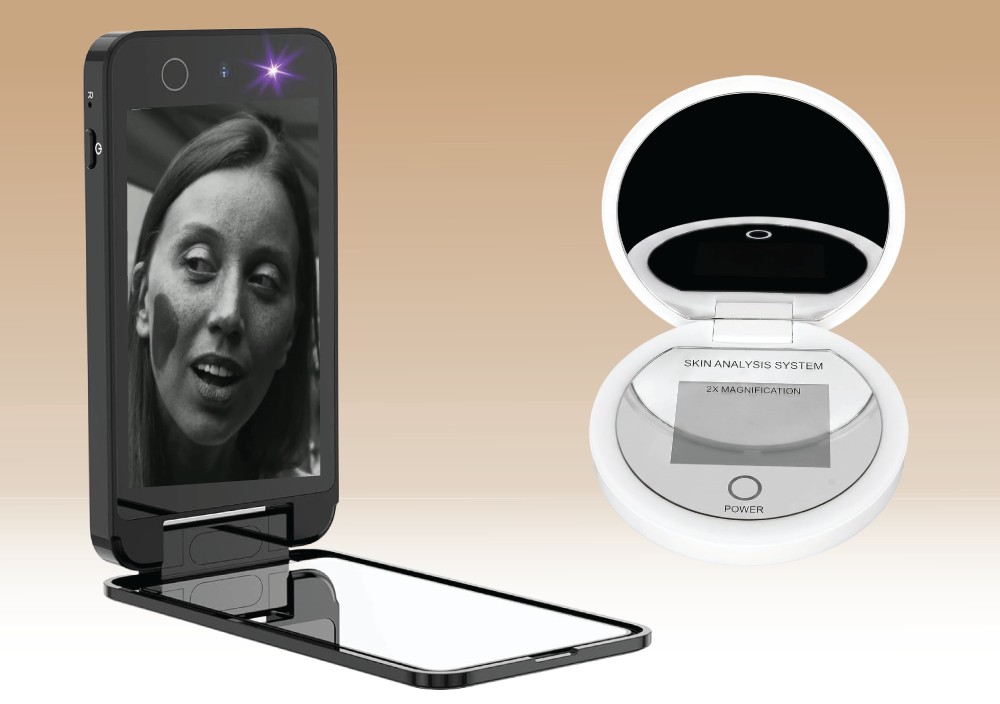
A UV mirror uses ultraviolet (UV) light to show where sunscreen has been applied to your skin.
- Properly applied sunscreen appears dark (chemical filters absorb UV and appear metallic black; mineral filters reflect UV and appear bright or blue)
- Unprotected skin remains lighter, making missed areas immediately visible
UV photography has been used in dermatology research for decades, but, recent consumer-oriented UV cameras (and webcams) have made this technology practical home use [1].
The Science Behind Why This Matters
Research consistently demonstrates a gap between how much sunscreen people think they apply and how much they actually use. Studies show that people typically apply only 25–50% of the amount used in laboratory testing, which can substantially reduce the protection they receive [2].
The problem isn’t just how much sunscreen we apply, but also where we apply it. A study using UV imaging in 57 participants found that the eyelids and areas around the eyes were frequently missed during routine sunscreen application [3]. These areas are particularly important to protect, as the eyelid is a common site for basal cell carcinoma (BCC), the most common type of eyelid cancer.
Other commonly missed areas include:
- Ears: The outer edges of the ears are common sites for squamous cell carcinoma (SCC).
- Hairline and temples: Often overlooked when applying sunscreen.
- Nose: Particularly the tip and sides.
- Neck: Especially the back and sides.
- Hands: Particularly the backs of the hands, which are frequently exposed to the sun.
These areas can receive regular sun exposure but are easy to overlook when applying sunscreen.
Does Seeing It Actually Change Behaviour?
Yes! Research supports the benefits of UV imaging. One study found that participants applied significantly more sunscreen after seeing UV photographs showing where they had missed areas of their skin [4].
Similarly, research by Pratt and colleagues found that UV images, combined with a simple information sheet, helped participants improve sunscreen coverage around their eyelids, an area they had often missed without realizing it [3].
Why does this work? UV radiation is invisible, so it’s difficult to know when our skin is being exposed. UV imaging makes the invisible visible, helping people see where they may have missed sunscreen and encouraging more thorough application.
A Particularly Powerful Tool for Families
UV mirrors are especially effective as educational tools for children and young people. Sun exposure in childhood is recognized as a crucial time for skin cancer risk habits formed early and continuing into adulthood.
Seeing sunscreen coverage in real time transforms sun safety from instruction into a hands-on experience. A UV mirror helps children understand not just that sunscreen matters, but precisely how to apply it thoroughly.
Given that UV damage is cumulative and that melanoma risk is meaningfully shaped by lifetime UV exposure beginning in childhood, building accurate application habits early has long-term value.
Want to Try a UV Mirror?
UV mirrors and cameras are available as educational tools to help visualize sunscreen coverage. They can be an interesting way to learn about sunscreen application and help identify areas you may have missed.
If you’re considering purchasing one, look for a device specifically designed for sunscreen visualization and check whether it is compatible with the sunscreen products you use.
Prevention Starts with What You Can See
UV radiation doesn’t announce itself. There’s no sensation of DNA damage occurring. The long-term consequences are photoaging, actinic keratoses, and skin cancer that emerge slowly over years and decades. Sunscreen is one of our most evidence-supported protective tools: in the best available randomized controlled trial, regular sunscreen use was associated with a 73% reduction in invasive melanoma in the daily-use group.
But that protection depends entirely on applying the right amount, to the right areas, consistently. A UV mirror doesn’t replace sunscreen or guarantee protection, but it can help you identify missed areas and improve how thoroughly you apply it.

About the Author: Katya is a fourth-year medical student in McGill University’s MDCM program, pursuing dermatology through CaRMS. Her research focuses on dermatology, skin cancer, health economics, and bioethics, and she has authored more than 50 peer-reviewed publications. She collaborates with dermatologists and patient organizations across Canada and mentors medical students interested in research. Outside of medicine, she enjoys film photography, graphic design, and pastel drawing.
References
[1] Horsham C, et al. Assessing sunscreen protection using UV photography: Descriptive study. JMIR Dermatol. 2021;4(1):e24653.
[2] Autier P, et al. Quantity of sunscreen used by European students. Br J Dermatol. 2001;144(2):288–291.
[3] Pratt H, et al. UV imaging reveals facial areas prone to skin cancer are disproportionately missed during sunscreen application. PLoS One. 2017;12(10):e0185297.
[4] Perry AE, et al. The effect of an ultraviolet photography educational exercise on sunscreen application. J Am Acad Dermatol. 2024 (published online).
[5] Green AC, Williams GM, Logan V, Strutton GM. Reduced melanoma after regular sunscreen use: randomized trial follow-up. J Clin Oncol. 2011;29(3):257–263.
[6] Holman DM, et al. Patterns of sunscreen use on specific body sites. Am J Prev Med. 2018;55(6):761–770.
[7] IARC Working Group. Radiation: Ultraviolet radiation. IARC Monographs. 2012;Vol. 100D.
[8] Neale R, Williams G, Green A. Application patterns among sunscreen users: randomized trial. Arch Dermatol. 2002;138(10):1319–1325.